
Parish at the Church of the Nativity of the Virgin Mary in Máriaremete
Location: Templom kert 1, 1029 Budapest, Hungary
Opening hours: Mo-Fri 7:00-12:00 AM; May – Sept.: Sat 8:30 AM – 7:00 PM, Sunday 7:00 AM – 7:00 PM. Oct. – April: Sat 8:30-12:00 AM, 5:30-7:00 PM, Sunday 7:00-12:00 AM and 5:30-7:00 PM.
Services: Holy Masses in the parish church: Mo, Tue: 7:00 and 10:30 AM; Wed, Thu, Fri: 10:30 AM; Sat: 10:30 and 6:00 PM, Sunday: 7:30, 9:00, 11:00 AM and 6 PM, all services are in Hungarian.
Parking: by car in nearby streets, buses can park along the Máriaremete str. here: https://maps.app.goo.gl/adKn25F9EtXwvEGV8. Parking is free of charge.
By public transport: take buses No. 57, 157 and 157A from Hűvösvölgy.
Pilgrims: it is possible to hold a holy mass or common prayer in the church for pilgrim groups upon request.
Contact an further information: mariaremete.plebania@gmail.com
History of the Shrine
In the mid-18th century a young woman, Katalin Thalwieser, came from the Danube riverhead to live in Hidegkút. She brought along a picture, a paper copy of the ancient statue of the Virgin of Einsiedeln (Switzerland). She fastened the picture to a roadside tree. People passing by would stop for a prayer at the picture. Many a prayer thus offered was found to be answered. To mention one example, a blind woman of Buda, Mrs. Forstmar, regained her sight after praying there. The landowner of the forest, Ignác Terstyánszky, first built a wooden chapel, then a small church of stone to house the picture. This church was consecrated in 1808, The great number of pilgrims, however, soon made it necessary to erect a larger church.
At the initiative of Dr. János Pauer, Diocesan Bishop of Székesfehérvár, an association was
established with the object to build a church in place of the chapel. As a result of their efforts, a church in neo-gothic style came to be built. It was consecrated on October 1, 1899 by Diocesan Bishop Fülöp Steiner to the honour of the birth of the Virgin. Pope Pius X permitted plenary indulgence to pilgrims attending the church, under the usual conditions. In 1928 the shrine was given into the care of the Servite Order, who was holding it in charge until 1950.
The Pope assigned the centenary of the apparition of the Immaculate Conception in Lourdes, 1958 the year of the Blessed Virgin. On this occasion, Pierre Théas, Bishop of Lourdes and Tarbes, donated the replica of the statue of Lourdes to Máriaremete. It was erected on the open-air altar, on a rock brought from Lourdes. In 1991, Pope John Paul II granted the Shrine of Máriaremete the honouring title of “basilica minor”. On October 3, 1999, on the occasion of the century of the consecration of the church, Georg Holzherr, Abbot of Einsiedeln, concelebrated the solemn mass with Papal Nuncio Joseph Rauber, and Diocesan Bishop of Székesfehérvár, Dr. Nándor Takács.
The Basilica is still a popular, well-attended shrine of the Virgin. Pilgrims seeking solace and healing come here from all over the country and even from abroad. Nearly 3000 marble votive tablets witness of the faith of believers, and of the great number of prayers answered. It is unfortunate that no minutes have been taken of all these cases but for a few, where miraculous healing could not be excluded.
Interior of the Church
The interior in its present form was designed by Prof. Dr. Alfréd Bardon, and built out 1963-64. The walls were repainted after the design by István Takács, churchpainter of Mezőkövesd. In accordance with the liturgical reform, the Picture was placed in front of the high altar, on a socle imitating a tree. The fresco decorating the arch represents the “Hommage of the Hungarian people to the Blessed Virgin”, with “The woman clothed with the sun” (Rev. 12,1) on top. At her right, the fresco shows the first Hungarian king, St. Stephan, on his knees, who recommended his land to the protection of the Virgin. The fresco lines up outstanding figures of Hungarian history: saints and famous Church personalities. The representation of the noonday bell has an eminent place, it recalls the victory over the
Turks at Belgrade, immortalising Hungarian heroism and veneration of the Blessed Virgin in Hungary.
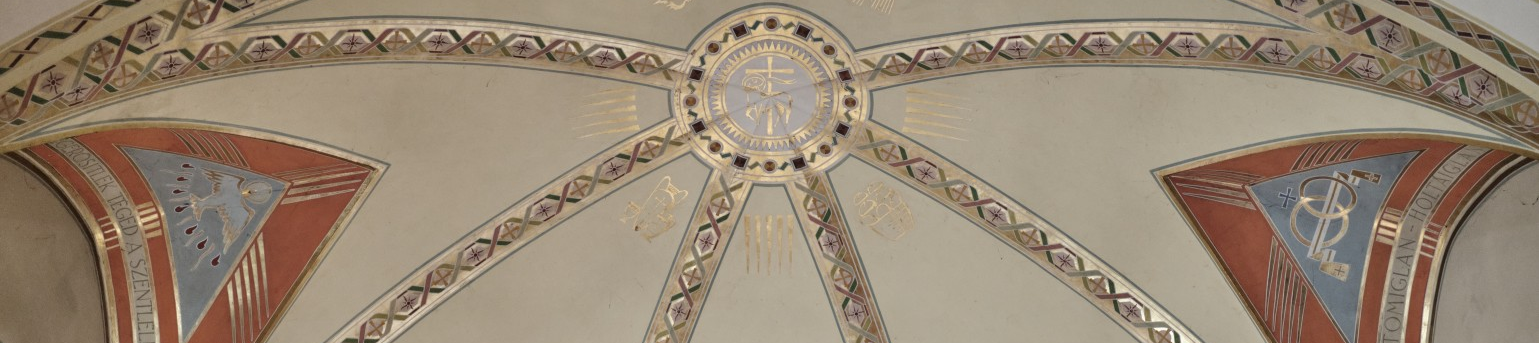
In the intersecting vaults of the aisle symbols of the seven sacraments are depicted. In the intersecting vaults of the nave symbols of the epithets of the Virgin are shown. The wall-surface below the choir is decorated with red marble votive tablets. In the aisle, around the Holy Cross and behind the Pietà, petitions and short prayers are written on the walls. The marble tablets of the nave record the names of donors contributing to the expenses of the construction of the church. The reliefs of the stations of pearwood are made by wood-carver István Bicskei. The organ of the church is also worth mentioning. It got to Máriaremete from Buda Castle, at the order of Francis Joseph I, King of Hungary.